Parashat Yitro and Disability Torah
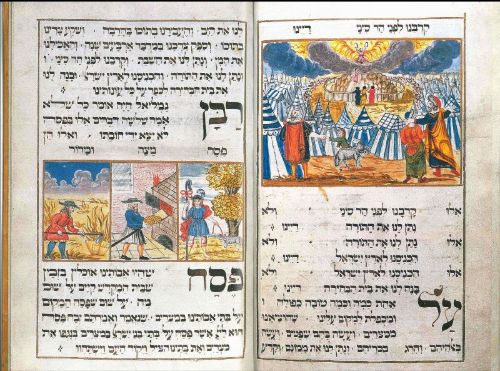
Banner is “Revelation at Mt. Sinai,” Moravian Haggadah, 1737, engraving, facsimile courtesy of Spertus Institute of Jewish Studies, Chicago. Found here
In this commentary, I approach Parashat Yitro, Exodus 18:1-20:23, through the lens of disability torah. To define disability torah I refer to a conversation between Dr. Judith Plascow and Rabbi Julia Watts Belser. Dr. Plascow has been writing and speaking about Jewish feminism since the early 1970s and is the author of several works on feminist theology. Rabbi Belser is a rabbi, scholar and spiritual teacher working at the intersections of disability studies and queer feminist Jewish ethics and environmental justice.
Blessing for Healing Ableism
Blessing for Healing Ableism
By Rabbi Elliot Kukla, Inspired by the words of Patty Berne, Aurora Levins Morales, and Leah Lakshmi Piepzna-Samarasinha
SVARA Cripping the Torah Session 6 December 22, 2022
May the one who blessed our disabled ancestors – Harriet Tubman, Mel Baggs, Carrie Ann Lucas, Ing Wong-Ward, Ki’tay Davidson, Laura Hershey, Stacy Park Milbern, and so many more—heal this world that regards sick and disabled people as disposable.
Our ancestors in the Torah guide us, not despite their disabilities, but in part because of their differences. Moses had a speech disability and was appointed by God as the spokesperson for the enslaved people. His sister Miriam fell ill, and the whole camp of 600,000 people waited for her during her quarantine. King Saul suffered from deep despair and David would soothe his soul with sweet music.
Let us dream together of a time when all of our access needs are met with unconditional love. A future when each of our bodyminds will be celebrated and caring for each other will be sanctified. We will leave no one behind as we roll, limp, stim, sign and create the living future that we all deserve.
May it be so!
Resources
Here are a few places to visit for information about accessibility and disability.
-
- Video on communication. Creator is autistic. Description “The first part is in my “native language,” and then the second part provides a translation, or at least an explanation. This is not a look-at-the-autie gawking freakshow as much as it is a statement about what gets considered thought, intelligence, personhood, language, and communication, and what does not
- Rabbi Professor Julia Watts Belser www.juliawattsbelser.com
- has written extensively on the portrayal of disability in rabbinic literature.
- “Violence, Disability, and the Politics of Healing” – Eiesland Endowment Lecture https://vimeo.com/123748777
- Disability and Climate Change Archive at Georgetown University
- Talk and paper on Jacob and the angel and disability dance
- In her article in Tikkun, “God has Wheels,” Belser talks about the transgressive potential of disability culture (if you are not a Tikkun subscriber, try ejournals at a public library).
- Rabbi Elliot Kukla
- Video of the talk Rabbi Kukla (no longer available) delivered about resisting the forces in society which want to brand as pathological the person who learns to accept chronic illness and even to draw creative energy from it.
- Rabbi Kukla has written about the magnificent art they created in the process of finding deeper meaning in their illness. The article includes a version of Rabbi Kukla’s Blessing for Healing Ableism
- Rabbi Kukla – link to The Holiness of Being Broken: Trauma and Disability Justice “Most of us will experience some form of trauma or wounding in our lifetime. Trauma and disability are essential parts of what make us human and what connects us to one another.”
- Article in New York times https://www.nytimes.com/2018/01/10/opinion/in-my-chronic-illness-i-found-a-deeper-meaning.html
- https://truthout.org/articles/disability-doesnt-make-us-less-worthy-of-life-covid-policy-assumes-it-does/
- Rabbi Lauren Tuchman
- Rabbi Ruti Regan https://www.facebook.com/RabbiRutiRegan “is a Conservative rabbi, feminist, ritual artist, and disabled disability advocate.”
- Matan A. Koch is the Senior Policy Advisor at RespectAbility, a nonprofit organization fighting stigmas and advancing opportunities so that people with disabilities can participate in all aspects of society.
- Many beautiful works of deaf art are collected here .
- https://jewishsacredaging.com/heroes-who-limp/ – Rabbi Steven Sager
- Joy Ladin https://www.keshetonline.org/resources/wrestling-till-dawn-parashat-vayishlach/ Wrestling Till Dawn (Parashat Vayishlach) [Torah Queeries] The author compares her own personal story of wrestling with her gender identity to Jacob’s life stories and struggles.
- Judy Heumann bio https://en.m.wikipedia.org/wiki/Judith_Heumann video https://youtu.be/qmGljzieVqA at about 15 minutes she starts talking about how virtual meetings in synagogues without closed captions or sign language do not provide deaf and hard of hearing with a good experience.
- The spoon theory was developed by Christine Miserandino but her site is no longer active. Find it on wikipedia
Celebrating Diversity – Refashioning our Synagogues and our Minds
Celebrating Diversity – Refashioning our Synagogues and our Minds
A small synagogue that I once belonged to has a ramp, an accessible bathroom, a large print siddur, and a braille siddur especially prepared with the order of service they customarily follow on Friday nights. The ramp was constructed a few years ago with a huge amount of work and good will and fundraising among that community. The accessible bathroom was built as part of a major renovation to the sanctuary a year later. The braille siddur was prepared by a blind woman who visited for a couple of services and offered to make it. The membership committee prepared the large print siddur.
These are all excellent starting places for accommoda
Vayikra: Why Is It Important To Be Called?
Parashat Vayikra, the first portion of the book of Leviticus, is foreign to our modern ears, with its rules for animal sacrifice, detailed requirements for what to do with each type of animal for different offerings, and rules about eating the fat and the blood. How can we understand this ritual? Nancy Jay [see sources at end of paper] points out that the way to understand ritual is not to try and find a meaning identical to the ritual actors, but to build a kind of bridge, “not to accurately decode their meaning, but to make what they do and say intelligible for us.” One way to do this is to consider that the ritual of sacrifice as presented in Leviticus some 2500 year ago is a method of creating a holy routine – instructions about how to bring holiness into our lives through sacred norms. As modern Jews, we don’t bring order through sacrifice, but we do bring order through our own ritual practices.
Although this seems like a satisfying meaning, there is a drawback.