Ruach HaYam Shabbaton Retreat October 19, 2013

Ruach HaYam Shabbaton Retreat October 19, 2013

SG_OT_304_Crossing_the_Red_Sea no copywrite
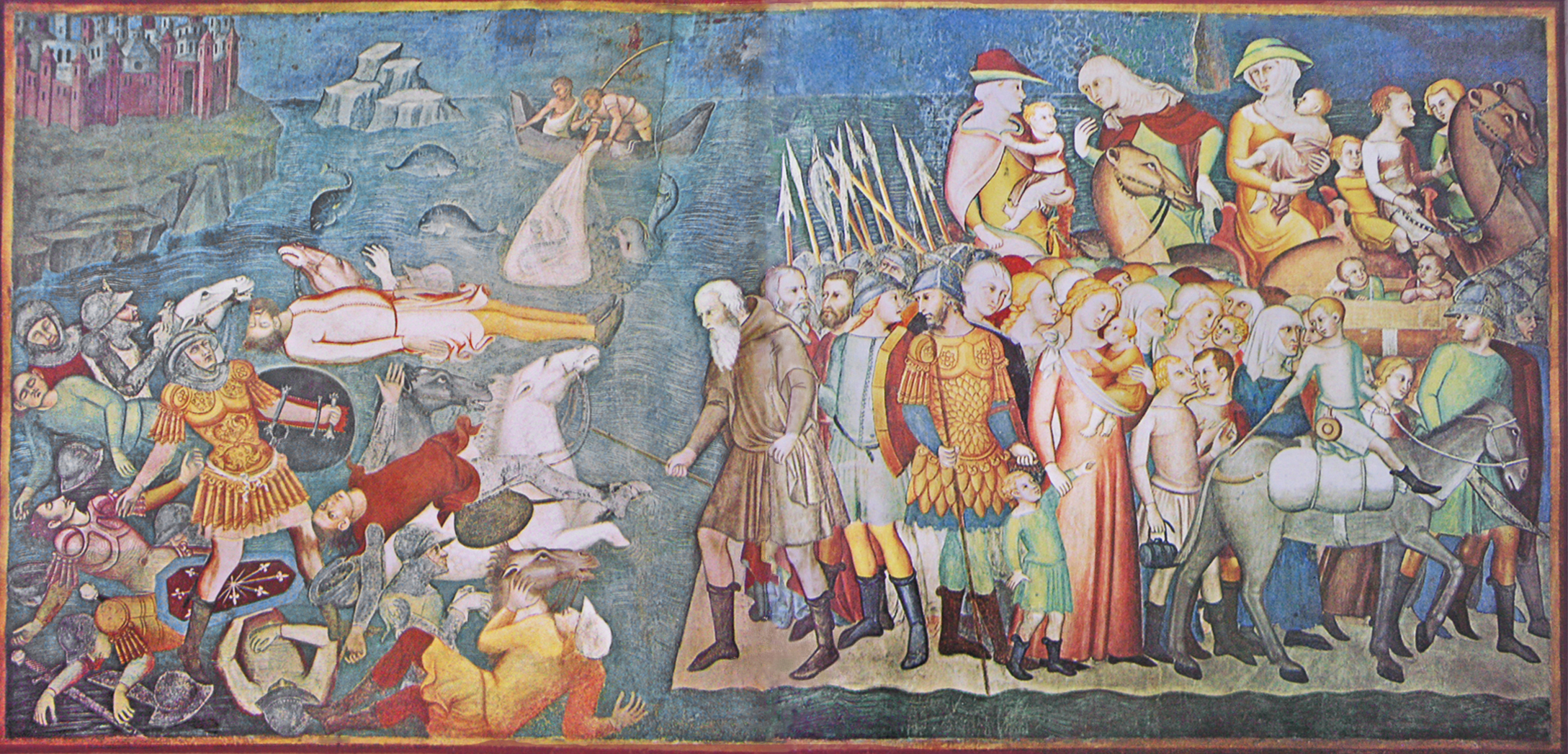
Collegiate Church of San Gimignano, Italy, 1356.  Israelites safely cross the Red Sea; Pharaoh and his troops are drowned.

Ruach HaYam, Congregation Am Tikva, and Keshet collaborate to present a full day Shabbat retreat for LGBTQ Jews and friends and family.  Refresh your spirit and make new friends in this fabulous day of egalitarian davening, creative and thoughtful workshops, and delicious food.  We close out the Shabbat retreat with Havdalah and live Klezmer music for dancing.  Retreat is directed by Penina Weinberg and co-sponsored by Congregation Eitz Chayim and StudywithPenina.

Shabbaton Retreat takes place at Congregation Eitz Chayim, 136 Magazine Street, Cambridge, MA 02139. Please note that pre-registration is required.  Fee for the full day, including two meals, is $36, with sliding scale options.  See registration form for details.

CLICK HERE TO REGISTER:  (you will be taken to Keshet webpage)

Please like and join the Ruach HaYam group on facebook to be updated.

Ruach HaYam is the Spirit of the Sea – is Miriam, Moses, and the mixed multitude, for the first time crossing over, transcending boundaries. There is a narrow and dangerous, but miraculous, parting of the sea – a point of transition between the known past (Egypt) and the unknown future (the desert and eventually the Land of Israel).
We are Jews (and friends and family) of all gender identities and expressions, rearranging and transcending our boundaries.  Ruach HaYam also calls to mind how near we are to the sea in New England.

Schedule
(see below for faculty and leader biographies)

Services

9:30 am to 11:30 – Led by members of Congregation Am Tikva

Lunch 

Noon to 1:30 pm

Workshops 

1:30 to 3:00 – Laurie Wolfe – Gender Detours, Destinations, and other True Stories
We picked a direction, we moved, we made changes, and now we are where? Are we in the place we thought we’d be? Are we truly in a different place? Are we where we’re supposed to be, and if not, what would that look like? Do we know at this point? Have we picked a new direction (or changed a prior one)? Did God, HaShem, Shekinah, Adonai play a part in your journey? And has your relationship to spirit or ritual changed and in what ways?  We will explore these questions through both listening to stories and telling our own.

3:00 to 3:45 – break

3:45 to 5:15 – Marla Brettschneider –  Smashing Binaries:  Golda Meir
The Golda Meir you never knew and who queers need. In this workshop we will explore Golda Meir’s radical legacy for us in a queer Jewish context. We will look at the ways that Meir smashed overlapping binaries central to Jewish life and thought in such areas as diaspora and queer theories. Participants might want to utilize Meir’s intense life experience to explore together the many ways in which we are still constricted by binary gender expectations and to look at strategies to more constructively challenge and accept them with ourselves and each other.

Third meal
5:15 to 6:30

Havdalah
6:30 to 7:00 – Havdalah Service Leader – Jeremy Sher
7:00 to 8:30 – Live Klezmer music and dancing – Shana Aisenberg
Shana will be playing traditional Eastern European klezmer music on violin and other instruments for dancing. Shana invites other musicians to play and/or sing along. Feel free to bring an instrument and even your own songs. Some music notation will be available.


Shabbaton Retreat Director

Penina Weinberg
Penina Weinberg is an independent biblical scholar who serves as president of Congregation Eitz Chayim in Cambridge, MA, and on the Boston Keshet community events committee. Her Masters Degree at Hebrew College concentrated on women-centered readings of biblical texts. Her studying and teaching focus a queer lens on the intersection of power and politics in the Hebrew Bible. Penina teaches at her synagogue, at other Boston area shuls, and at Nehirim and Keshet.


Partners

Congregation Am Tikva
Congregation Am Tikva began in 1976 to provide a safe and welcoming space for GLBT Jews to pray together and to socialize. It created its own gender-neutral prayerbooks and customs for Friday evening services, the high holidays, and special events, such as the Erev Pride Liberation Seder. Am Tikva is a mixture of genders and sexualities who come from a variety of Jewish backgrounds. The services reflect that variety. Am Tikva offers two Friday evening services a month, one more contemporary and one more traditional, as well as High Holiday services, and celebrations of other queer and Jewish holidays.
Keshet
Keshet is a national grassroots organization that works for the full equality and inclusion of lesbian, gay, bisexual, and transgender (LGBT) Jews in Jewish life. Led and supported by LGBT Jews and straight allies, Keshet strives to cultivate the spirit and practice of inclusion in all parts of the Jewish community. What began as a small, grassroots group working for change in the Greater Boston area, is are now a national organization with offices in the Bay Area and Denver, in addition to the national office in Boston


Faculty and Leaders (in order of appearance)

Laurie WolfeBilicious_LaurieWolfe_100px
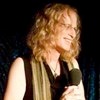
Laurie Wolfe is a writer, poet, performer, activist, speaker, trainer and an alternative healer of people and pets. Laurie has appeared in Bilicious Boston 2 and 3; Boundless: Body Verse, and the VDay Boston productions of The Vagina Monologues. She’s emceed Trew Tales, Keshet’s LGBTQ/Jewish Open Mic about our gender journeys. She’s been a trainer for SpeakOut Boston and is on the MTPC (Massachusetts Transgender Political Coalition) Training Committee. She will be appearing in Bilicious Boston 4 at Club Café on November 8th and 9th.


Marla Brettschneider Marla
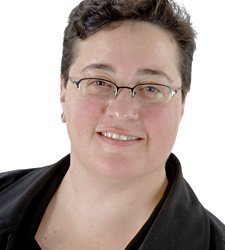
Dr. Marla Brettschneider is Professor of Political Philosophy at the University of New Hampshire with a joint appointment in Political Science and Women’s Studies. She is founder and past Coordinator of Queer Studies and has long been serving as Coordinator of Women’s Studies. Marla has written widely on Jewish politics, queer and other diversity matters. Her most recent book The Family Flamboyant: Race Politics, Queer Families, Jewish Lives (SUNY 2006) won an IPPY (Independent Book Publishers Award) in the GLBT category.  Her workshop today is from her current project on the revolutionary legacies of Jewish feminist political thinkers and activists.


Jeremy Sher
Jeremy Sher is a rabbinical student at Organic Torah Institute and is studying for his M.Div. at Harvard Divinity School.  He currently serves as Student Rabbi at Congregation Eitz Chayim.  He has taught extensively in the Jewish community in New England and Seattle, including at Keshet and Isabella Freedman.  He lives in Cambridge, where he is a dedicated Freemason and an avid cyclist.


ShanaShana Aisenberg
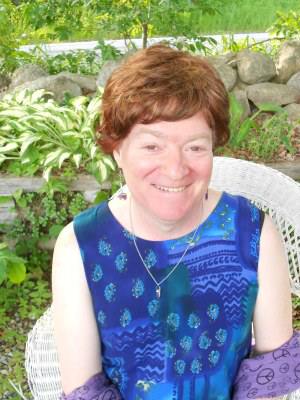
Shana Aisenberg is an acoustic multi-instrumentalist, composing, playing, recording and teaching diverse styles from traditional Appalachian, Celtic and New England contradance music to eastern European Klezmer, Balkan, blues, jazz and classical. She sings and plays a wide array of stringed instruments including fiddle, mandolin, bouzouki, acoustic guitar, banjo, fretted dulcimer, ukulele, and frame drums. Shana often performs with her partner Beverly Woods in the duo String Equinox. Shana has recently embarked on Cantorial studies, and is truly enjoying her return to being a redhead!


CLICK HERE TO REGISTER:  (you will be taken to Keshet webpage)

II Sam Ch 17 – Wed April 3 – 7:30pm to 9:00pm


All are welcome, whether regular attendees or first time visitors: prior text study experience is not necessary.

Absalom has his father King David on the run, across the Jordan River.  Why is King David running?  Who are the unsung heroic women who help King David’s spies warn him to move away from danger?  Why are so many of David’s sons and nephews fighting amongst themselves? Come to class on Wednesday to find the answers to these questions, and to ask many questions for which there will be no answers!

Study with Penina: 1st and 3rd Wednesday evenings
Now in our 4th year on the Early Prophets
Eitz Chayim, 136 Magazine Street, Cambridge

  • Study is in English, interfaith and gender sensitive.
  • Bring your Tanakh (Bible) if you have one; books are provided as needed.
  • Feel free to bring snacks or a bottle of wine.

I  look forward to learning with you!

Reading Ruth as a Tapestry

I am very excited to be teaching at Brookline Community Beit Midrash

5 week series between Pesach and Shavuot

4/8/13, 4/15/13, 4/22/13 (self-study on 4/29/13), 5/6/13, 5/13/13

I’m calling the series Reading Ruth as Tapestry. We will engage in a close reading of the Book of Ruth, making meaning as though we were weaving a tapestry.  Our warp consists of the major themes: Ruth and Shavuot; David’s ancestors; individuals in relationship to community and the divine.  Our woof contains the modes of interpretation: our own reading; the Sages; modern –  including feminist, queer and traditional; woodcut art.  Study will be multi level and accessible to all.

The Brookline Community Beit Midrash (BCBM) is a warm and welcoming, non-denominational community of engaged and committed learners who meet weekly at Congregation Kehillath Israel on Monday nights, 7-9pm. BCBM believes that an energized learning atmosphere leads to a stronger community, new friendships, and a deeper connection to our Jewish tradition.  BCBM is centered on the principle that Torah should be accessible to all who wish to learn.

For information on the Brookline Community Beit Midrash, you may

2 Samuel Chapter 16 – March 20

Study with Penina March 20, 7:30pm.
Regularly 1st and 3rd Wednesday evenings
Congregation Eitz Chayim 136 Magazine Street, Cambridge

The story of King David continues to be a messy family story.  His sons and nephews are at odds with each other; who should get the throne is not clear.  Women in this chapter will only suffer.  As Samuel said in Book I: “I will call unto YHVH to send thunder and rain;  and you shall know and see that your wickedness is great, which you have done in the sight of YHVH, in asking a king for yourselves.”  (1 Sam 12:17).

  • Study is in English, interfaith and gender sensitive.
  • Bring your Tanakh (Bible) if you have one; books are provided as needed.
  • Feel free to bring snacks or a bottle of wine.

All are welcome, whether regular attendees or first time visitors: prior text study experience is not necessary.

I  look forward to learning with you!

Transitions Through Gray (and Desert)

The last few months I walked at lunch down the bike path in Lexington, MA.   Many winter days were cold and windy, but the trees looked alive and full – snowy rather than leafy green.  Sunlight blazed off the white landscape.

A few days ago we had a mild early spring day, about 50.  Snow had been melting all week.   I noticed when I left my yard how muddy it looked, brown, worn out, and tired.  The fall leaves, which I allow to cover my plants to warm them under the snow in the winter, were now naked again, rotting, and drab.  During my walk I was amazed to realize that this point of transition from winter to spring, although warmish and evocative of spring, was disappointingly colorless.

The winter days were cold, but brilliant and invigorating.  The budding spring, when it’s warm and sunny, is simply marvelous.   But the in-between space…..  It was gray, and I had to work my mind hard to remember the jumping off point, and where I would land after crossing the desert.  Perhaps the grayness of the day fooled me, and made the past look better, as Egypt did to the children of Israel as they crossed the desert.   Perhaps I need to question my notion of beauty, and look for a way to appreciate the crossing itself.

II Samuel Ch 15

Join us on March 6, 2013 to read 2 Sam 15.  Learn about Absalom’s attempt to usurp the kingdom from David.  How is Absalom able to “steal the hearts of the men of Israel (v 6)” and manage to send David running from Jerusalem?   Read how David cleverly installs five spies inside of Jerusalem, and insists that the Ark remain in the holy city, while fatally exposing his wives to abuse by leaving them behind (v. 16).

II Samuel 12-14: Tamar and the Wise Woman of Tekoa

On February 14, 2013, we studied 2 Samuel 14.  With the help of the wise woman of Tekoa, King David has to face a tough decision about his sons. Who is this woman, and is she really wise? What are the stakes for King David at this point?
“The Tekoan woman helps him reach a decision concerning the great struggle that was going on within him: the struggle between his personal feelings and his moral obligations. The parable provides David with a ladder with which to climb down from ‘the moral tree’ which he had climbed following Avshalom’s flight. This justification, however, has no grounding in concrete reality. As he had done in earlier stories, David once again makes an erroneous decision, one for which he will yet be forced to pay a heavy price.  https://www.etzion.org.il/en/88-chapter-14-i-woman-tekoa 

On February 6, 2013, we studied 2 Sam Ch 12:3-12 – the tragedy of Tamar. It’s an emotional roller coaster, and an amazing look at the corruption of power.  We compared with the story of Dinah (Gen 34).
“In this new monarchy, the weak can still be victimized by the powerful, girls are vulnerable to violence, and violence against them still spreads unchecked until it culminates in civil war.  The monarchy does not solve the problem that is its only reason for being: it cannot govern society so that outrage will not occur.”  – Tikva Frymer-Kensky Reading the Women of the Bible

How Six Women gave Moses His Start in Life – January 6 at Eitz Chayim

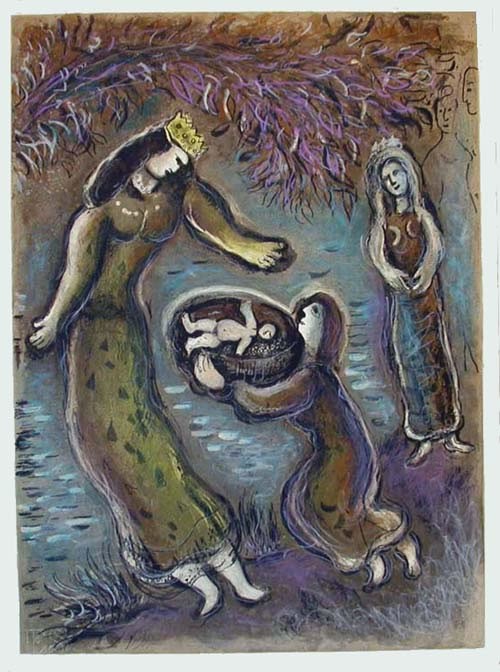
 Marc Chagall, "Pharaoh's Daughter and Moses, from The Story of Exodus"Consider the six powerful women who midwifed, mothered, and sistered Moses and gave him his start in life. Despite contrary decrees by the powerful Pharaoh of Egypt, they used their wits to gain power when they lacked authority and launched Moses as a prophet and leader.
Eitz Chayim member Penina Weinberg, who is both student and teacher of Hebrew Bible, will guide us on reading selected passages from Exodus and entering a lively discussion relating our texts to current politics, philosophy, or challenges of life.

Marc Chagall, “Pharaoh’s Daughter and Moses
from The Story of Exodus

Study session is participatory and accessible to people with no experience studying biblical texts, while providing an intellectual challenge to those with a broad background. Everyone is an expert at something; we will combine our insights and knowledge to unpack the biblical texts and to wrestle with questions such as: what is the meaning of our texts? What is authority vs power? Is living by our wits relevant today?

Please join us for bagels and coffee at 10am. Study and discussion at 10:30am.
Congregation Eitz Chayim is at 136 Magazine Street in Cambridge, MA.

II Samuel Ch 11-12: Bathsheba

“The story of David’s taking of Bathsheba and murder of Uriah (chaps. 11-12) and the subsequent story of rape, murder, and rebellion (chaps. 13-20) tell us….it is a threat from within, a corruption that grows from within himself and his own family, that most menaces David’s exercise of power.  From this point on, despite enlivening moments, David’s story becomes increasingly bleak.”
    –The HarperCollins Bible Commentary, 2000.  David M. Gunn  “II Samuel”. pp 267-8)

Ay, that incestuous, that adulterate beast,
With witchcraft of his wit, with traitorous gifts-
O wicked wit and gifts, that have the power
So to seduce!- won to his shameful lust
The will of my most seeming-virtuous queen.

But that I am forbid
To tell the secrets of my prison house,
I could a tale unfold whose lightest word
Would harrow up thy soul, freeze thy young blood,
Make thy two eyes, like stars, start from their spheres,
Thy knotted and combined locks to part,
And each particular hair to stand on end
Like quills upon the fretful porcupine.
—-Hamlet Act I, Scene 5

II Samuel Ch 8-9-10: David, the Philistines, and Mephibosheth

Chapter 8 ends with David at the absolute apex of his powers and reputation.   He finally subdues the Philistines who have been the mortal enemies of the Israelites.   From here David tackles the Ammonites, the Moabites, the Arameans…….  But does he start to lose himself?   Is there something suspicious about David hunting down Saul’s last remaining relative, Mephibosheth, and sequestering him at the royal table?

Pay attention to what battles David leads and which ones he sits out in Chapter 10.  Notably, while he defeats the Arameans, he leaves the Ammonites for Joab to defeat later.  This incomplete work on David’s part foreshadows his sitting out the entire season in which the kings normally go out to battle (Chapter 11).