Ruach HaYam teaching presented by Penina Weinberg February 28 2021
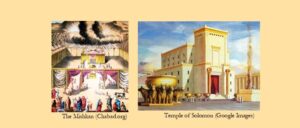
Building Mishkan vs Temple: Willing Heart vs Corvee Labor Feb 28 2021
Ruach HaYam teaching presented by Penina Weinberg February 28 2021
Ruach HaYam teaching presented by Penina Weinberg January 21, 2021
Ruach HaYam teaching presented by Penina Weinber
Picture is a photo of a small hannukiah lit in the midst of a great cold wind on the cobblestone front porch of an empty house on a Maine beach on the 6th day of Hanukkah in 2019.
No, we’re not at Hanukkah yet, but we are at the Jewish calendar date 3 Kislev, the beginning of the month in which Hanukkah falls, and the darkest month of the year. We are two days after the new moon of Kislev. We can take hope in candles lit against the darkness. We are also at Parashat Toldot, Genesis 25:19-28:9, wherein Rebecca makes the most existential cry of the entire Torah, and Jacob and Esau fight against the gender roles assigned them at birth, reversing them with the support of the Divine and Rebecca. And we’re at Transgender Day of Remembrance. As Jill Hammer writes below, we are in a time of introspection and outward action. We’ll talk about the texts, about Judith and Rebecca, about gender roles, and about how to bring light into darkness.
Jill Hammer’s book The Jewish Book of Days: A Companion for All Seasons situates each day of the year in its season, quarter, phase, and part of nature. Jill writes this about Kislev, in ancient Israel:
“Once the new moon was announced, bonfires were lit in the hills above Jerusalem. Far-flung communities would see the bonfires and light their own, until all the Jewish communities knew that the new moon had come. As stars help a ship locate itself on the sea, the bonfires helped Jews locate themselves in time, joining them to the root consciousness of their people.
According to Rabbi Judah, the 1st of Kislev is the first day of winter in Israel (Babylonian Talmud, Bava Metzi’a 106b). We are close now to the darkest days of the year, and the new moon bonfires remind us of the Hanukkah candles growing each night. The flames teach that when the moon is dark, we can expect its face to shine again, and when the sunlight is dimming, soon it will begin to grow again. This is true also for us: The quiet of introspection can and should lead to outward action in the world.”
Penina Weinberg is an independent Hebrew bible scholar whose study and teaching focus on the intersection of power, politics and gender in the Hebrew Bible. She has run workshops for Nehirim and Keshet and has been teaching Hebrew bible for 10 years. She has written in Tikkun and HBI blog, and is the leader and founder of Ruach HaYam.
*** Ruach HaYam https://www.facebook.com/groups/Ruach.HaYam/ study sessions provide a queer Jewish look at text, and are welcoming to LGBTQ+ and allies, to any learning or faith background, to all bodies, and friendly to beginners***
Ruach HaYam teaching presented by Penina Weinberg October 22, 2020
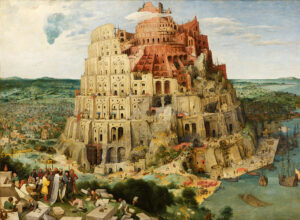
The story of the Tower of Babel, Gen 11:1-9, is included in the Torah portion for this week: Parashat Noach. This enigmatic story comprises only a few verses, and seems to indicate that a crime against God has been committed. But what is the crime? What in fact are the builders doing? The city of Babel seems actually more important than the Tower.
Judy Klitsner, author of “Subversive Sequels in the Bible: How Biblical Stories Mine and Undermine Each Other” suggests that “In tyrannizing one another by extinguishing the divine spark of individuality, the tower builders made standing before God impossible.” Is this, as she says, a story about a “coercively conformist society,” or about genuine explorers? How big a part is played by the fact that city building then required slavery?
This will be a lively discussion, light on text, geared to everyone who has ever puzzled over the Tower of Babel. Will we find any answers? ABSOLUTELY NOT! Will we have fun trying? YES!
Picture is Tower of Babel by Pieter Bruegel the Elder (1573). Yellow and orange two tone stair step edifice with doors and windows towering over a plain of green. On the side of the plain to the right is a green river with small sailing craft. In front of tower on the plain to the left is a knot of men – perhaps engaged in discussing the building of the tower.
Penina Weinberg is an independent Hebrew bible scholar whose study and teaching focus on the intersection of power, politics and gender in the Hebrew Bible. She has run workshops for Nehirim and Keshet and has been teaching Hebrew bible for 10 years. She has written in Tikkun and HBI blog, and is the leader and founder of Ruach HaYam.
*** Ruach HaYam https://www.facebook.com/groups/Ruach.HaYam/ study sessions provide a queer Jewish look at text, and are welcoming to LGBTQ+ and allies, to any learning or faith background, to all bodies, and friendly to beginners***
Ruach HaYam teaching presented by Penina Weinberg August 20, 2020 At 6:45pm ET, meeting will be open for logging in, schmoozing and solving any technical issues. [see below for details] Study begins at 7:15 ET.
——>>>>>> Zoom login can be found in the Ruach HaYam study room https://www.studywithpenina.com/ruach_hayam ——>>>>>> Only recognized names will be admitted to Zoom meeting. Please be sure to RSVPBanner image is by David Lawrence and can be found at Octobergallery.com, which is one of the oldest African American art galleries in the nation. Lawrence’s Shekinah is a proud Black woman, lit from above and behind, who appears to see into your soul and out from hers.
Penina will be sharing a number of ideas which are interrelated, pulling together teachings and thoughts from Joy Ladin, Rabbi Julia Watts Belser, and “The New Jim Crow – Mass Incarceration in the Age of Colorblindness” by Michelle Alexander. This will be a conversation, thinking together about ideas of sin, victimization, racism, the voices of the prophets, the rabbis and the Shekhinah. This is very much a work in progress for Penina and she looks forward to thinking in community with friends of Ruach HaYam. Alexander writes that one of the false ideas that drives mass incarceration of Black men – perpetuating a vast underclass that is identical to slavery – is the notion that Black men would not be imprisoned if they did not commit crimes. (Her book is based upon research on incarcerated Black men). This notion blames the victims of systemic racism for the injustices perpetrated upon them and justifies the loss of voting privileges, housing, employment and family. How is this notion similar or not to the Hebrew Bible claim that the downfall of the temples and the fall of the monarchy are the result of failures of the Israelites to worship as their God demands? Is the God of punishment in effect blaming the victim instead of the overwhelming might of Israel’s enemies: the Assyrians, Babylonians and Romans? Do the Prophets speak the language of blame the victim sometimes, and other times the language of the Shekhinah? We will consider two teachings. One is Joy Ladin’s new poetry collection in process, called “Shekhinah Speaks”. Ladin’s Shekhinah is a bad-ass fully independent female divinity, not in the least a binary reflection of a male divinity. This Shekhinah is not the God of punishment, but the God who stands by the side of the human, flesh to flesh, pushing, prodding, saving from the ground up. Ladin describes Shekhinah as an alternative, decentralized, binary-dissolving way of thinking about how the Divine moves in and through us to make a more just society. You can learn in detail about this here Rabbi Julia Watts-Belser, in her book “Rabbinic Tales of Destruction: Gender, Sex, and Disability in the Ruins of Jerusalem” presents a teaching on how the destruction of the Temple in Roman times is treated in Bavli Gittin. Here, she says, the rabbis do not blame the victims, do not suggest that Jerusalem fell to the Romans because they sinned and God punished. Instead the rabbis describe the overwhelming force of the Roman conquerors and the toll they take upon the bodies of the people. You can see a teaching by Rabbi Belser, where she reflects on “The God Who Suffers With” here Perhaps we will find Belser’s “God With” is a bit like Ladin’s “Shekhinah” Penina Weinberg is an independent Hebrew bible scholar whose study and teaching focus on the intersection of power, politics and gender in the Hebrew Bible. She has run workshops for Nehirim and Keshet and has been teaching Hebrew bible for 10 years. She has written in Tikkun and HBI blog, and is the leader and founder of Ruach HaYam. *** Ruach HaYam https://www.facebook.com/groups/Ruach.HaYam/ study sessions provide a queer Jewish look at text, and are welcoming to LGBTQ+ and allies, to any learning or faith background, to all bodies, and friendly to beginners***Ruach HaYam teaching presented by Penina Weinberg July 23, 2020 At 6:45pm ET, meeting will be open for logging in, schmoozing and solving any technical issues. [see below for details] Study begins at 7:15 ET.
——>>>>>> Zoom login can be found in the Ruach HaYam study room https://www.studywithpenina.com/ruach_hayam ——>>>>>> Only recognized names will be admitted to Zoom meeting. Please be sure to RSVPImage is Deuteronomy, decorated initial-word panel from BL Harley 7621, f. 254v. Date 1450-1474 c British Library
Devarim is partly a restatement of the history to date of the Israelites, but told in a new way. Why does it change? How does the text (or Moses?) rewrite history and memory? What can we learn about modern day re-writing of history? Join us for a lively deep dive into the first portion of Devarim, quite logically called Parashat Devarim.
Devarim 1:16—18: [Moses speaking to the Israelites] “I commanded your judges at that time saying, hear out the cases of your brethren and adjudicate righteously between a man and his fellow and the immigrant residing with him (גר). Do not be partial in judgment: hear out the small as well as the large. Fear no man, for judgment is God’s. And any case that is too difficult for you, you shall bring it to me and I will hear it.” Penina Weinberg is an independent Hebrew bible scholar whose study and teaching focus on the intersection of power, politics and gender in the Hebrew Bible. She has run workshops for Nehirim and Keshet and has been teaching Hebrew bible for 10 years. She has written in Tikkun and HBI blog, and is the leader and founder of Ruach HaYam. *** Ruach HaYam https://www.facebook.com/groups/Ruach.HaYam/ study sessions provide a queer Jewish look at text, and are welcoming to LGBTQ+ and allies, to any learning or faith background, to all bodies, and friendly to beginners***