Queers look at parashat Yitro (Jan 23, 2022)

Ruach HaYam teaching presented by Penina Weinberg January 23, 2022

This is the week (or the Sunday after) of the Torah portion Yitro, Exodus 18:1-20:23. We will explore one or more of the fabulous topics in this section of the Torah.
—> Why did Zipporah disappear and reappear? —> Burnout/Self Care [Yitro and Moses] —> God as Eagle [gender considerations of the Eternal] —> According to the story of the Revelation at Sinai/ Synesthesia, we access revelation in different ways, but they are all equally valid ways of access [Disability Justice issues – R Lauren Tuchman might be our supplementary reading] —> The Decalogue (“10 commandments”)
Closer to the date, there will be some study materials here: https://tinyurl.com/RuHayYitro
If you have read this far, mazel tov. Here is an added treat. Feel free to zoom into Temple Beth Israel Waltham on Saturday January 22, to see how Rabbi David Finklelestein will approach this topic as part of our Hashmiini series https://tbiwaltham.org/local-rabbi-brings-marginalized…/ Alas we will not likely be davenning in person
Banner is “Revelation at Mt. Sinai,” Moravian Haggadah, 1737, engraving, facsimile courtesy of Spertus Institute of Jewish Studies, Chicago. Found on https://ivc.lib.rochester.edu/seeing-the-sounds…/ At 7 pm ET, meeting will be open for logging in, schmoozing and solving any technical issues. Study begins at 7:15 ET. We will go until 8:45 pm. ——>>>>>> Zoom login can be found in the Ruach HaYam study room. https://www.studywithpenina.com/ruach_hayam ——>>>>>> Only recognized names will be admitted to Zoom meeting. Please be sure to RSVP Penina Weinberg is an independent Hebrew bible scholar whose study and teaching focus on the intersection of power, politics and gender in the Hebrew Bible. She has run workshops for Nehirim and Keshet and has been teaching Hebrew bible for 10 years. She has written in Tikkun and HBI blog, and is the leader and founder of Ruach HaYam. *** Ruach HaYam https://www.facebook.com/groups/Ruach.HaYam/ study sessions provide a queer Jewish look at text, and are welcoming to LGBTQ+ and allies, to any learning or faith background, to all bodies, and friendly to beginners***
Chanukah queer Torah schmooze for all (Dec 5 2021)

Ruach HaYam teaching presented by Penina Weinberg December 5, 2021

This evening is the 8th candle of Chanukah. If you celebrate, bring your menorah!! We’ll dip into texts appropriate to the season: a few excerpts from Judith, midrash about Chanukah, interesting texts and poetry. Judith is a truly multifaith heroine so we have stories for everyone. Feel free to contribute a memory from our intensive study of Judith in the Time Before and/or a favorite song. The study will be eclectic, relaxed, hopefully a tad festive Banner is a Hanukiah depicting Judith, Italy, 19th century(?) The Jewish Museum, NY. At 7 pm ET, meeting will be open for logging in, schmoozing and solving any technical issues. Study begins at 7:15 ET. We will go until 8:45 pm. ——>>>>>> Zoom login can be found in the Ruach HaYam study room. https://www.studywithpenina.com/ruach_hayam ——>>>>>> Only recognized names will be admitted to Zoom meeting. Please be sure to RSVP Penina Weinberg is an independent Hebrew bible scholar whose study and teaching focus on the intersection of power, politics and gender in the Hebrew Bible. She has run workshops for Nehirim and Keshet and has been teaching Hebrew bible for 10 years. She has written in Tikkun and HBI blog, and is the leader and founder of Ruach HaYam. *** Ruach HaYam https://www.facebook.com/groups/Ruach.HaYam/ study sessions provide a queer Jewish look at text, and are welcoming to LGBTQ+ and allies, to any learning or faith background, to all bodies, and friendly to beginners***
Moses Views the Promised Land in the Middle of the Creation of the World (Oct 17, 2021)

Ruach HaYam teaching presented by Penina Weinberg October 17, 2021

At the end of the Jewish liturgical year, in the fall, after Yom Kippur, on Simchat Torah, Jews read Parashah V’Zot HaBerachah, which is the very end of Deuteronomy, the last book of the 5 books which make up the Torah, and which are read portion by portion though the cycle of one year. On the very same evening, Jews read the beginning of the Torah, Genesis 1:1–2:3. What does it mean to envision the end of the life of Moses as deeply connected to and leading to the Creation of the World? We will read the end of Deuteronomy and the beginning of Genesis and see how death and birth are connected; how ends become beginnings.
We will also read some 1st millennium Aramaic poetry about the death of Moses, including Jochebed mourning the death of her son and Moses talking to Adam. Time permitting, we may look at how Isis and Jochebed are similar and different in searching for their loved ones. Look for all these things to be showing up here if you’d like to read in advance. https://tinyurl.com/RuHay-Moses—Creation
  Middle of banner is a 1912 painting “Moses Beholds the Promised Land” by Christian Rohlfs. We see a very strong character with dark skin and draped in red who stands face to face with the promised land.The artist combines a realistic portrayal with powerful colours and an expressive, almost brash technique. Sides of banner are two ends of the six days of creation, as depicted in a 17th century Armenian Bible, preserved in the Armenian Patriarchate, Jerusalem. The first panel, upper left, shows God commencing to create the universe from chaos. In the second panel, middle left, the orb apparently represents God’s command “Let there be light” (Genesis 1:3), actually a part of the first day’s work; while the arch in the background seems to be the “firmament in the midst of the waters” (Genesis 1:6). The creation of the Earth and its vegetation appears in the bottom left panel. On the fourth day, upper right panel, God made the stars, shown in the blue band as some of the zodiacal constellations, as well as the sun and the moon, seen in the panel’s upper corners. The fifth panel, middle right, vividly realizes God’s creation of the creatures in the sea and of the birds who “fly above the earth across the firmament of the heavens” (Genesis 1:20). Finally, God made the creatures of the earth, including mankind, on the sixth day, lower right. Among the animals shown in the sixth panel is the mythical unicorn, which has a single, long horn jutting from its forehead. At 6:45 pm ET, meeting will be open for logging in, schmoozing and solving any technical issues. Study begins at 7:00 ET. We will go until 8:30 pm. ——>>>>>> Zoom login can be found in the Ruach HaYam study room. https://www.studywithpenina.com/ruach_hayam ——>>>>>> Only recognized names will be admitted to Zoom meeting. Please be sure to RSVP Penina Weinberg is an independent Hebrew bible scholar whose study and teaching focus on the intersection of power, politics and gender in the Hebrew Bible. She has run workshops for Nehirim and Keshet and has been teaching Hebrew bible for 10 years. She has written in Tikkun and HBI blog, and is the leader and founder of Ruach HaYam. *** Ruach HaYam https://www.facebook.com/groups/Ruach.HaYam/ study sessions provide a queer Jewish look at text, and are welcoming to LGBTQ+ and allies, to any learning or faith background, to all bodies, and friendly to beginners***
Hannah Narrative: Thunder, Trouble, and Following Our Inner Voice (August 26 2021)

Ruach HaYam teaching presented by Penina Weinberg August 26, 2021

The Hannah Narrative is recited by Jews every year on the first day of Rosh Hashanah, the New Year (this year falling on September 7). Through a close reading of 1 Samuel 1 we will prepare ourselves to hear the thunder of change and the quiet inner voice of our souls.   You will find source sheets here: https://tinyurl.com/RuHay-Hannah Although Hannah is held up as a model of prayer by Jews and Christians alike, how often do we ask what Hannah is actually praying for? What is her heart crying out for? What inner strength does she call on? What external prods and goads does she have? Does Hannah want to be recognized as being more than she appears? Can we as queer folk dig into our transgressive hearts to find a new understanding of Hannah as a woman whose dreams may reach beyond being mother and wife? And what is the role of Hannah’s co-wife, Penninah? Is she a nuisance or a holy troubler of the waters? You may wish to read a commentary I wrote a few years ago. You may enjoy this except from Marcia Falk’s Un’taneh Tokef (page 29 in her book “The Days Between”) A great shofar is sounded And a voice of slender silence is heard. The voice is one’s own a reed in the chorus a breath in the wind Banner is an etching by Marc Chagall (1958): “Hannah Evokes the Eternal.” Hannah in red robe is prominent in the foreground and stretching up to pray. Smaller in background is a figure who appears to be uncomfortable or disdainful. A few livestock are looking on. At 6:45pm ET, meeting will be open for logging in, schmoozing and solving any technical issues. [see below for details] Study begins at 7:15 ET. ——>>>>>> Zoom login can be found in the Ruach HaYam study room https://www.studywithpenina.com/ruach_hayam ——>>>>>> Only recognized names will be admitted to Zoom meeting. Please be sure to RSVP Penina Weinberg is an independent Hebrew bible scholar whose study and teaching focus on the intersection of power, politics and gender in the Hebrew Bible. She has run workshops for Nehirim and Keshet and has been teaching Hebrew bible for 10 years. She has written in Tikkun and HBI blog, and is the leader and founder of Ruach HaYam. *** Ruach HaYam https://www.facebook.com/groups/Ruach.HaYam/ study sessions provide a queer Jewish look at text, and are welcoming to LGBTQ+ and allies, to any learning or faith background, to all bodies, and friendly to beginners***
Tzara’at (“leprosy”) and Salvation – Inside and Outside the Gates (June 24 2021)

Ruach HaYam teaching presented by Penina Weinberg June 24, 2021

In 2 Kings chapters 5-7 we find stories of three different types of men affiliated with tzara’at. Usually (mis)translated in the Bible as “leprosy,” it is an unsightly skin affliction which generally results in the sufferer being excluded from community until they can become cured and purified. In this cycle of stories, we have the non-Israelite King Naaman who is leprous; Gehazi, the servant of the prophet Elisha, who becomes leprous; and four lepers sitting outside the gates of Samaria waiting to die. We will read these stories for comic element, to learn about Elisha’s miracle working, and to ponder class differences in treatment of illness.
We will look especially at the story of the four lepers who build their own community outside the gates, and who “precisely because of their vantage point, outside of society, perceive God’s salvation, which would otherwise have been missed by the nation.” [Rav Alex Israel] I wish to think through some of the lessons of Liam Hooper’s book, “Trans-Forming Proclamation: A Transgender Theology of Daring Existence,” which I feel teaches that the knowledge gained by those who are outside the gates is transformational – not in order to survive as outcasts but in order to repair the world. There is a positive energy that can radiate from those who have had to care for each other outside the gates, and who bring their knowledge to those in the city, in fact transforming those who othered them.
Banner shows Naaman the Syrian bathing in the waters of the Jordan River at the advice of the prophet Elisha and ridding himself of his leprosy (2 Kings 5). Woodcut from the Cologne Bible, 1478-80.
At 6:45pm ET, meeting will be open for logging in, schmoozing and solving any technical issues. [see below for details] Study begins at 7:15 ET. ——>>>>>> Zoom login can be found in the Ruach HaYam study room https://www.studywithpenina.com/ruach_hayam ——>>>>>> Only recognized names will be admitted to Zoom meeting. Please be sure to RSVP Penina Weinberg is an independent Hebrew bible scholar whose study and teaching focus on the intersection of power, politics and gender in the Hebrew Bible. She has run workshops for Nehirim and Keshet and has been teaching Hebrew bible for 10 years. She has written in Tikkun and HBI blog, and is the leader and founder of Ruach HaYam. *** Ruach HaYam https://www.facebook.com/groups/Ruach.HaYam/ study sessions provide a queer Jewish look at text, and are welcoming to LGBTQ+ and allies, to any learning or faith background, to all bodies, and friendly to beginners***

Ruth and Naomi: The Divine of Human Relationship (May 20 2021)

Ruach HaYam teaching presented by Penina Weinberg May 20, 2021

The book of Ruth poses hard questions about the relationship between humanity and God, and between one human and another. Like Job, Naomi agonizes over being abandoned by God, even afflicted by God. The community of Naomi’s birth rejects her upon her return. Yet Ruth is able to transform the village and effect Naomi’s restoration to respected elder. What does it mean that God can afflict human beings? Ruth and Naomi sit outside the gates at the beginning. What is the role of women in transforming society? What is the role of marginalized people generally in the repair of the world? What can we apply from Liam Hooper’s teaching in April?
Tikva Frymer Kensky writes: it is up to humanity to ensure that the foundations of the earth do not totter. The way to do this is right behavior and social justice. This is an enormous task, but the way to accomplish it has been revealed: God has instructed and continues to instruct the people as to how they are to behave. “In the Wake of the Goddesses”, pg 106
We will read the book of Ruth with the teachings of Liam and Frymer-Kensky in mind – looking for fresh insights on the meaning of chesed and how to perform it.
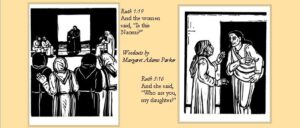
Banner shows two woodcuts by Margaret Adams Parker. In both, Naomi and Ruth and villagers are portrayed as long robed and hard laboring – not the common idyllic scenes. First image shows Naomi entering her old village, drooping, supported by Ruth. Caption “Ruth 1:19 – And the women said, ‘Is this Naomi?’” Second image shows Naomi looking up at Ruth. Caption “Ruth 3:16 – And she said, ‘Who are you my daughter?’”
At 6:45pm ET, meeting will be open for logging in, schmoozing and solving any technical issues. [see below for details] Study begins at 7:15 ET. ——>>>>>> Zoom login can be found in the Ruach HaYam study room https://www.studywithpenina.com/ruach_hayam ——>>>>>> Only recognized names will be admitted to Zoom meeting. Please be sure to RSVP Penina Weinberg is an independent Hebrew bible scholar whose study and teaching focus on the intersection of power, politics and gender in the Hebrew Bible. She has run workshops for Nehirim and Keshet and has been teaching Hebrew bible for 10 years. She has written in Tikkun and HBI blog, and is the leader and founder of Ruach HaYam. *** Ruach HaYam https://www.facebook.com/groups/Ruach.HaYam/ study sessions provide a queer Jewish look at text, and are welcoming to LGBTQ+ and allies, to any learning or faith background, to all bodies, and friendly to beginners***

“Beyond the Gates of the City”: Locating G-d’s Social Torah (April 22, 2021)

Ruach HaYam teaching presented by a fabulous guest teacher, Liam Hooper, author of “Trans-Forming Proclamation: A Transgender Theology of Daring Existence”!!  April 22, 2021.
Reading I Kings 17 (especially, vs 2-16) as literature moves us beyond the surface narrative and overt prophecies to reveal the messages below the narrative that are conveyed in the allegory.
Delving into the elements of the story allows us to apprehend some implications of the values and priorities held by the god-character.
In his book, “Trans-Forming Proclamation: A Transgender Theology of Daring Existence”, Liam Hooper develops the following conclusions: “For God, no element of creation – be it seasonal wadi, grain for bread, or plot of ground to grow it – is expendable. No member of creation is too small, too weak, too unlikely, or too strange to participate in the good of God’s cosmic household. Moreover, no single person is expendable.”
From here, Liam proposes that there are profound social justice messages in the tale of Elijah, the widow of Zarephath, her son, the ravens, and the wadi.
Join us for a discussion of the implications found in this god-character’s interventions with the outcasts beyond the gates of the city.
Liam’s book is not required reading, but it is highly recommended. For this class, Chapter 8 is of particular interest. You can look for the book on Amazon or through your local independent bookstore.
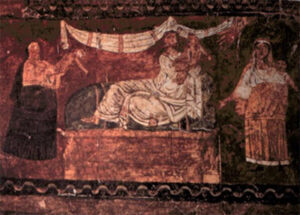
Image: Elijah Restores the Widow’s child. Third century C.E. Detail of a wall painting from the Dura Europos synagogue (Syria). https://www.bibleodyssey.org/…/e/elijah-dura-europos Paintings from the synagogue in Dura Europos, a city on the Euphrates River in Syria, represent the earliest continuous narrative cycle of biblical images ever discovered. The synagogue was built between 244 and 245 C.E. and destroyed in 256 C.E. when the Sassanids (Neo-Persians) sacked the city. French–American excavations of the site in the 1920s marked a new beginning in the study of Jewish art. The continuous action of the painting, looking from left to right, shows the widow, dressed in mourning black, giving Elijah her dead son. In the center, Elijah revives the boy, with God’s outstretched hand appearing in the upper right. On the right, the widow appears again in colorful garments, holding her living son. At 6:45pm ET, meeting will be open for logging in, schmoozing and solving any technical issues. [see below for details] Study begins at 7:15 ET. ——>>>>>> Zoom login can be found in the Ruach HaYam study room https://www.studywithpenina.com/ruach_hayam ——>>>>>> Only recognized names will be admitted to Zoom meeting. Please be sure to RSVP Penina Weinberg is an independent Hebrew bible scholar whose study and teaching focus on the intersection of power, politics and gender in the Hebrew Bible. She has run workshops for Nehirim and Keshet and has been teaching Hebrew bible for 10 years. She has written in Tikkun and HBI blog, and is the leader and founder of Ruach HaYam. *** Ruach HaYam https://www.facebook.com/groups/Ruach.HaYam/ study sessions provide a queer Jewish look at text, and are welcoming to LGBTQ+ and allies, to any learning or faith background, to all bodies, and friendly to beginners***

Queerly Meeting Elijah the Prophet (March 18 2021)

Ruach HaYam teaching presented by Penina Weinberg March 18 2021
Who is the prophet Elijah? We studied his despair and triumph over the prophets of Baal a couple years ago. Now we will look at some of the other wonderful tales, including his miraculous ascent to heaven and the close resemblance of his life to the life of Moses. We will be preparing to welcome Elijah to our Pesach tables.
“Elijah, whom the Bible portrays as an angry, jealous prophet who fights without mercy and without compromise against the worship of Baal, is transformed in post-biblical Jewish literature into a man of infinite kindness and grace, the benevolent prophet who helps people in need. He appears in Rabbinic academies, reveals hidden mysteries, rescues victims of blood libel, arrives to every Passover seder, is present at every circumcision ceremony, and more.” Shinan, Avigdor, and Yair Zakovitch. From Gods to God: How the Bible Debunked, Suppressed, or Changed Ancient Myths and Legends.
This introduction to Elijah will also prepare us to welcome Liam Hooper as co-leader on April 22. Liam is the author of a new book: //Trans-Forming Proclamation: A Transgender Theology of Daring Existence.// Liam reads Elijah with with an eye toward the ethical responsibilities and obligations we have as humans. For Liam, Elijah’s story, as literature, is a story of the human lot that is packed with ethical teaching.
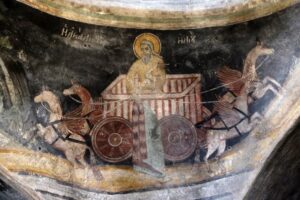
Image: Prophet Elijah going up to heaven, fresco in the Saint Naum Monastery near Ohrid in Macedonia. At 6:45pm ET, meeting will be open for logging in, schmoozing and solving any technical issues. [see below for details] Study begins at 7:15 ET. ——>>>>>> Zoom login can be found in the Ruach HaYam study room https://www.studywithpenina.com/ruach_hayam ——>>>>>> Only recognized names will be admitted to Zoom meeting. Please be sure to RSVP Penina Weinberg is an independent Hebrew bible scholar whose study and teaching focus on the intersection of power, politics and gender in the Hebrew Bible. She has run workshops for Nehirim and Keshet and has been teaching Hebrew bible for 10 years. She has written in Tikkun and HBI blog, and is the leader and founder of Ruach HaYam. *** Ruach HaYam https://www.facebook.com/groups/Ruach.HaYam/ study sessions provide a queer Jewish look at text, and are welcoming to LGBTQ+ and allies, to any learning or faith background, to all bodies, and friendly to beginners***

Building Mishkan vs Temple: Willing Heart vs Corvee Labor Feb 28 2021

Ruach HaYam teaching presented by Penina Weinberg February 28 2021
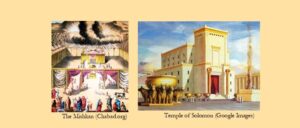
We will compare parashat Terumah (the week’s Torah reading) to 1 Kings, where Solomon builds the temple with corvee labor, resulting in the immediate rebellion of the Northern Kingdom when Solomon dies. We will mine the texts for what it means to come to an enterprise (or our lives) with an inclined/willing heart, vs an imposed obligation.
We will note that those who built and decorated the mishkan were all genders – craft persons of all materials, and that the mishkan was fabulous in its decoration. We will compare this to the Temple being constructed by indentured (corvee) labor (all male?) We’ll look at the intention of the builders (Moses and Solomon), and at the resulting buildings and carry forward our study of the heart.
On the left, a drawing from Chabad.org of the desert mishkan – with colorful clothing and draperies and giant billows of mystical smoke signifying the presence of God. On the right, an unattributed painting of Solomon’s temple with a great gold basin, gold pillars, brass or gold bowls, and a tall and very imposing enclosed building, with a thin funnel of smoke down front. At 6:45pm ET, meeting will be open for logging in, schmoozing and solving any technical issues. [see below for details] Study begins at 7:15 ET. ——>>>>>> Zoom login can be found in the Ruach HaYam study room https://www.studywithpenina.com/ruach_hayam ——>>>>>> Only recognized names will be admitted to Zoom meeting. Please be sure to RSVP Penina Weinberg is an independent Hebrew bible scholar whose study and teaching focus on the intersection of power, politics and gender in the Hebrew Bible. She has run workshops for Nehirim and Keshet and has been teaching Hebrew bible for 10 years. She has written in Tikkun and HBI blog, and is the leader and founder of Ruach HaYam. *** Ruach HaYam https://www.facebook.com/groups/Ruach.HaYam/ study sessions provide a queer Jewish look at text, and are welcoming to LGBTQ+ and allies, to any learning or faith background, to all bodies, and friendly to beginners***

The Heart of Judah: The Force of Female Formation Jan 21 2021

Ruach HaYam teaching presented by Penina Weinberg January 21, 2021
This is a study about the heart of Judah. We will look at what may possibly form/transform Judah’s heart, and read an interesting rabbinic commentary that illustrates how Judah’s heart enables him to “draw near” to his estranged brother Joseph “in order to arouse Joseph’s love and spark his compassion.”
I will suggest that Judah’s heart is steeped in the maternal/divine connection with his mother Leah. It is further tempered by Tamar’s lesson about righteousness. Judah first leads his brothers in saving Joseph’s life, then demonstrates great love for his father. In the end his heart reaches out directly to Joseph’s heart “in order to arouse Joseph’s love and spark his compassion.”
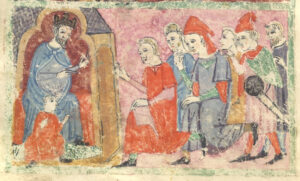
Banner: Judah and his brothers negotiating with Joseph. From the 14th century “Sister Haggadah” Spain, Catalonia (Barcelona). 1325-1374 CE. Copyright: British Library [Public domain]
At 6:45pm ET, meeting will be open for logging in, schmoozing and solving any technical issues. [see below for details] Study begins at 7:15 ET. ——>>>>>> Zoom login can be found in the Ruach HaYam study room https://www.studywithpenina.com/ruach_hayam ——>>>>>> Only recognized names will be admitted to Zoom meeting. Please be sure to RSVP Penina Weinberg is an independent Hebrew bible scholar whose study and teaching focus on the intersection of power, politics and gender in the Hebrew Bible. She has run workshops for Nehirim and Keshet and has been teaching Hebrew bible for 10 years. She has written in Tikkun and HBI blog, and is the leader and founder of Ruach HaYam. *** Ruach HaYam https://www.facebook.com/groups/Ruach.HaYam/ study sessions provide a queer Jewish look at text, and are welcoming to LGBTQ+ and allies, to any learning or faith background, to all bodies, and friendly to beginners***