Brief story of Judith

In the Septuagint (LLX), Judith is a bad-ass heroine, heartily accepted and lauded by her people after she saves them from Holofernes. She is portrayed as quite independent – relying upon her faith in God, but very inner directed, brave, and splendid. Lots of intertextual links to Jewish heroes, male and female. Jerome’s Latin Vulgate (4th C CE) turns her into a chaste super pious widow who is basically following God’s direction – still a heroine, story much the same, but more directed – not so much agency – and not so fully respected. A story you would expect from a celibate Christian priest.

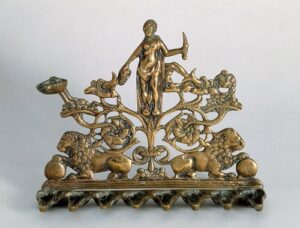
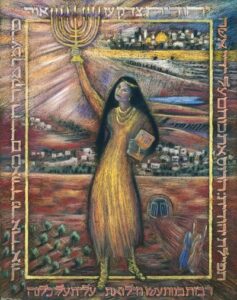
There is zero in Jewish tradition concerning Judith until about 1000 CE. Never was a Hebrew version of the LLX story. Jerome, in making the Latin Vulgate claims to have translated from Hebrew but this cannot be established. None of the Jewish historians, philosophers or rabbis mention her until she appears in the middle ages. Her story then is similar to LLX, but gets wrapped into multiple midrashic and liturgical stories of Hanukkah and Judah. She becomes quite prominent as a Jewish heroine (see first illustration – above), perhaps partly because it is a time of increasing nationalism (12th-14th centuries or so), perhaps in reaction to Christian adoration of the Virgin Mary. Judith remains a hero to the Jewish people over time (see second illustration).
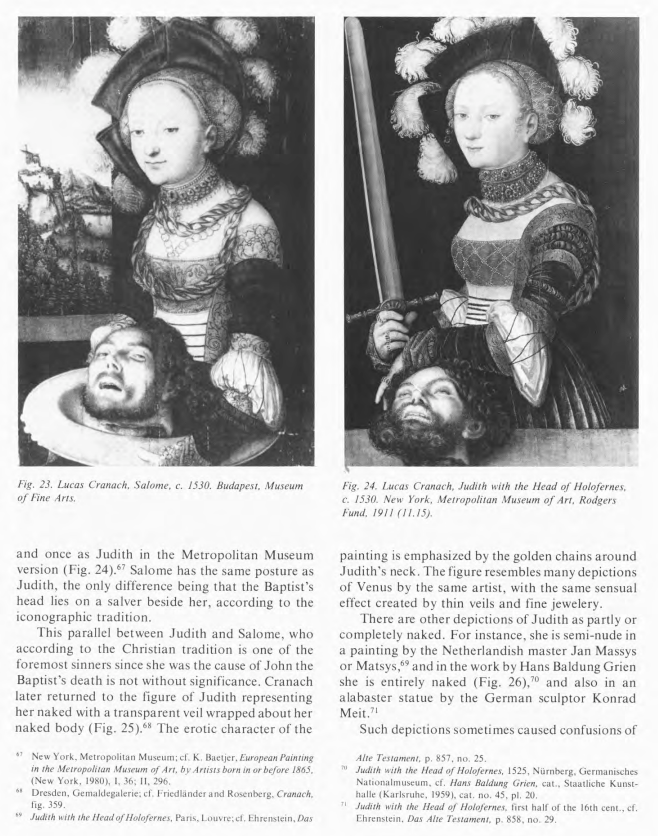
Christian art in the 15th century mixed Judith up with quite misogynist views of women. The art in last frame shows that she was conflated with Salome and both were portrayed as rather vile seducers.
Judith – Warrior, Priestess, Savior, Femme Fatale? (Aug 22, Sept 19, 2019)

Ruach HaYam teaching presented by Penina Weinberg at Congregation Eitz Chayim, 136 Magazine Street, Cambridge, MA – 6:45pm.  Part one: Aug 22.   Part two: Sept 19, 2019. RSVP (Scroll to end for logistics) [Artwork Judith before Holofernes, Hamburg Miscellany, Meinz (?), ca. 1428–1434. Hamburg, Staats-und Universitätsbibliothek, Cod. Hebr. 37, fol. 80v, detail (© Staats-und Universitätsbibliothek, Hamburg). Everyone has heard of Judith. Isn’t she the woman who separated Holofernes from his head? And something or other about Hanukkah? Join us at Ruach HaYam *** (a queer Havurah based in Cambridge, MA) for a two session study of the book of Judith. Each class will be different – come to one or both as your time permits. First encountered in a scroll that did not enter the Hebrew Bible, but became very important in Christianity, Judith does not become a Jewish heroine, or appear in rabbinic sources, until the middle ages, 1,000 years later, when Megillat Yehudit (the “Scroll of Judith”) and other midrashim in Hebrew surface. The midrashim draw fascinating parallels between Judith and Deborah, Jael, Esther, Ruth, David and many others. And of course tie Judith into Hanukkah. Judith is a woman who has been called warrior, priestess, feminist icon, slave of the patriarchy, icon of piety and celibacy, seductress, femme fatale, independent, wise, androgynous. Indeed Judith may be the woman of the bible/Jewish tradition who has had the most contradictory reception. Judith is a fascinating study in herself, as well as a good lesson on how we read our own values into the text. We will look at the deutero-canonical Book of Judith authored in antiquity in Greek, as well as Megillat Yehudit written in Hebrew sometime before 1402 CE. There are many online sources for self study. Penina Weinberg is an independent Hebrew bible scholar whose study and teaching focus on the intersection of power, politics and gender in the Hebrew Bible. She has run workshops for Nehirim and Keshet and has been teaching Hebrew bible for 10 years. She has written in Tikkun and HBI blog, and is the leader and founder of Ruach HaYam. ** Logistics** Study starts promptly at 7:15 pm. We open the doors at 6:45 for schmoozing. Feel free to bring your own veggie snack for the early part. A parking consideration is in effect for the three blocks around EC during all regularly scheduled events. It is a good idea to put a note in the windshield that you are attending an event at EC. Accessibility information: all gender/accessible bathrooms, entry ramp. *** Ruach HaYam study sessions provide a queer Jewish look at text, and are welcoming to any queers and allies, to any learning or faith background, to all bodies, and friendly to beginners.***